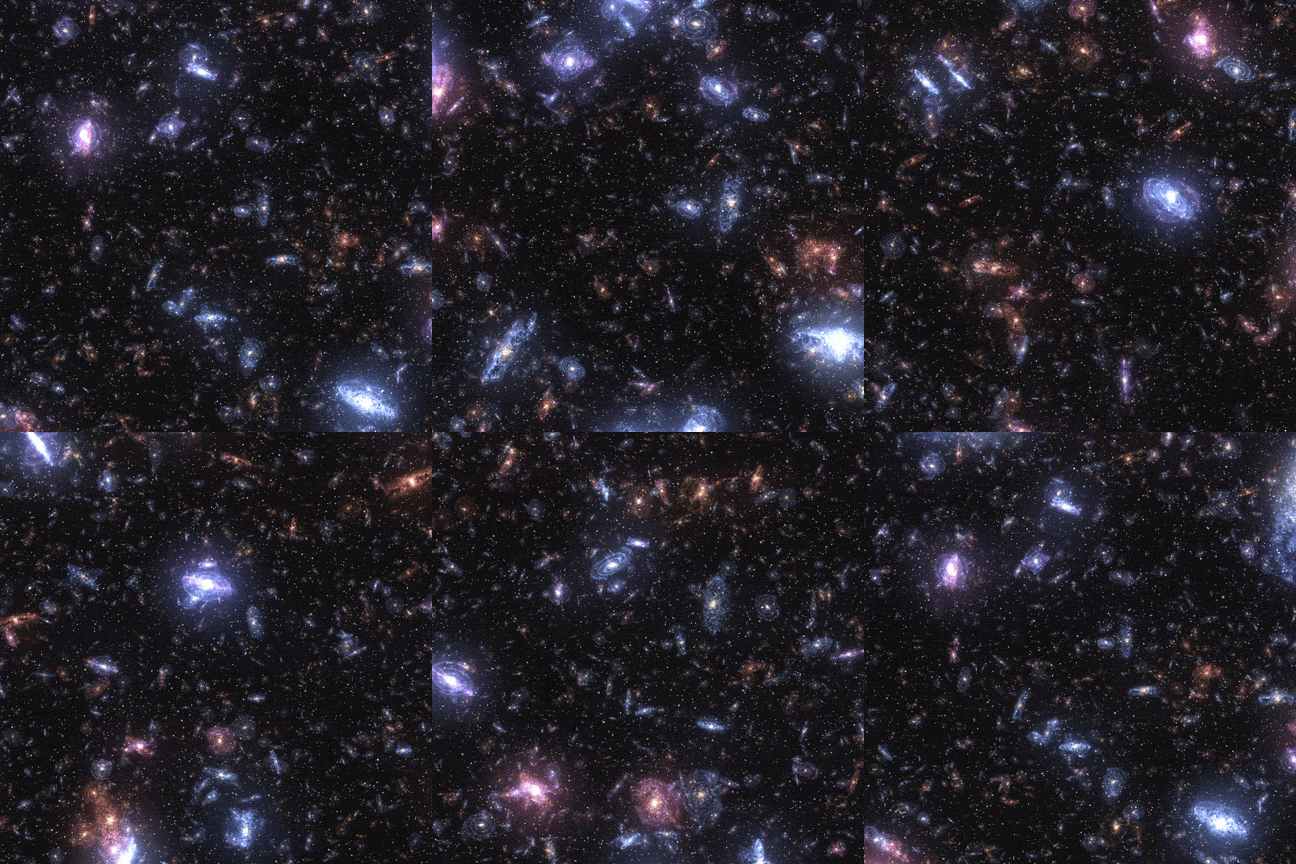
Fusing artificial intelligence and creativity is rapidly transforming how music is imagined and produced. Modern AI tools can now analyse musical data from around the world, learn patterns of melody and rhythm, and generate original compositions complete with lyrics. These do not simply mimic existing songs but instead recombine the learnt patterns to produce something new with surprising emotional resonance. For decades, creating music was a privilege of those with access to instruments, studios, or formal training. Today, what once demanded years of practice in composition and instrumentation can today be accomplished with a single descriptive prompt. This shift is not only technical but cultural, opening doors for anyone to transform imagination into sound and music.
While exploring this new frontier, I came across SUNO – an AI music creation tool, and was inspired to create music. I chose the concept of Interstellar travel which has been one of my childhood fascinations. The theme for creating the song roughly was: A voyage to a distant galaxy in a generation ship – designed like floating citiy – set on a path to another planet light-years away in hopes of finding a second home – echoing themes from Kim Stanley Robinson’s Aurora. The track that was produced based on a collection and refinement of prompts was quite a revelation. It was atmospheric and haunting, perfectly aligned with the idea of a lonely yet hopeful journey.
It was an emotional moment, because as someone without formal training in music, yet an intense interest and passion, I could finally translate a personal vision into music that can touch your soul. It was proof that even non-musicians can now turn their imaginative visions into soundscapes. The accessibility of composing the sense of wonder and mystery I imagined was truly fascinating. I didn’t need to have deep knowledge of music creation, understand chord progressions, or production software. It felt like collaborating with an ace musician and a music producer combined into one, who could instantly translate abstract ideas into heart warming renditions.
But the magic dimmed when I tried to extend that into a music video created from the song, using AI. Unlike AI-based music tools, AI video generation tools could only deliver short bursts of animation making it very challenging to just generate a music video based on prompts. I could have given up but at this point I was consumed by the idea of creating a music video for the song that I had created. So, began the arduous task of stitching small clips (some generated by AI, others just motion clips from the internet) together into a longer narrative to fit the song. The result was patchy, with noticeable jumps in style and pacing, but visually striking as individual elements. One clip showed an astronaut suspended along the vast space backdrop, while the next transitioned into a surreal tunnel of neon-lit geometric shapes. Yet, there was something very cool about this amateurish production attempt at a music video. And here is the end result of this endeavor:
I could have stopped there. But something kept gnawing at me and I couldn’t help but wonder how this music video would turn out if it was made by someone who actually knew what they were doing. Hoping to resolve this disjointed effect, I decided to collaborate with an expert. I scoured freelance services websites looking for videographers and creative artists who could bring my vision to reality. I indexed on people who use AI to hone their craft and use cutting edge tools. I finally found someone with the right skillset at the right price point. His creation was distinctively more professional, smoother, and easier on the eye. It had dramatic visuals and captured emotional nuances of the theme. Yet the final piece could have been even more compelling if enough time and effort was put into this collaboration. Is this a void that AI can fill in the future? I walked away from this experience with the learning that creating a polished, cinematic experience with AI tools as of today requires patience, editing skills, using AI tools that are still very limited in their feature set. While it can dramatically accelerate the creative journey, getting it right will still take significant effort and human ingenuity, or the results need to be tempered with a willingness to compromise. Here is the link to the final version of the video now hosted on YouTube:
I found a lot of value in this journey that I undertook. The imperfections reminded me that creativity is less about flawless execution and more about honest expression. AI acted as a bridge between my imagination and output, enabling me to share an idea I couldn’t have realized otherwise. The process wasn’t smooth, and the results weren’t flawless, but they were mine. That, to me, is where the true potential lies.
Just as synthesizers once sparked debates about replacing musicians, AI today raises similar fears. AI might democratize creative tools, but it still relies on human judgment, storytelling, and emotion, preserving the need for originality and human creativity. Its future is not about erasing human creativity, but about reimagining what creativity can be when you are given the tools to bring your imagination to life through a medium you have never even touched before. It gives more people the ability to turn abstract ideas into tangible art, helping others see what they want to express.
Looking ahead, as these systems mature, I can imagine a time when full songs and professional grade music videos will be created in a vibe – from nothing more than a description of thoughts and emotions. What takes months now, will take minutes. A future where expressing a single feeling could instantly generate both a soundtrack and its visuals will revolutionize film, advertisement, or even personal journaling. In my opinion, we are 5 years away from tsunami of creation that is going to hit us. A world where each one of us is an artist and a producer. We will have production grade soundtracks and visuals at our beck and call, and be only limited by our imaginations. What will become valuable in this world, is original story telling, emotional connection, and authenticity. There will be no dearth of quality content, made to order music and movies, personalization of story lines, alternate endings, and perhaps many different sequels of a hit movie or series. What will become hard though, is finding the right content, that speaks to you. We will be drowning in this ocean of high quality content but discovery of this content might become a favorite pass time and perhaps something even more.
At the same time, questions of copyright and ownership will become a hot topic. Who owns the rights to a song generated by an algorithm trained on thousands of artists? How do we balance innovation with respect for originality? These debates will shape how society adopts AI as a creative partner. Until then, AI remains a co-creator: powerful, imperfect, and deeply inspiring.
I was inspired enough to start a YouTube music channel. Here I plan to post AI co-created songs and music videos that I have already created and will do so in the future. If you liked what you saw, please subscribe to my YouTube channel and spread the word around.
Thanks for reading.
Update
Since I published this blog article, I have fully immersed myself into music video generation using AI, and found many a compelling tool. At least one of them is more advanced than others (that I know of) and I have been using this tool to create music videos of some of my other songs, also created using AI. I am posting this to a newly created YouTube Channel. Please visit the channel or follow the link belows to see these music videos. Feel free to comment and leave any feedback. And I would appreciate it if you like and subscribe.